
CT ↔ Manhattan Executive Car Playbook
Congestion Relief Zone tolls, curb legality, and zero-stress pickup language (2026)
Updated: January 2026
CT to Manhattan car service transfers derail for the same three reasons—week after week:
The vehicle crosses into the Congestion Relief Zone earlier than intended
The chosen curb turns out to be illegal for even a short stop
The rider sends one unhelpful text: “I’m outside.”
This playbook is designed for meeting-day execution, not theory. It’s written for executive assistants, frequent travelers, and professional chauffeurs who need predictable pickups at Penn Station / Moynihan, Midtown, Hudson Yards, and Wall Street in 2026.
What you’ll get
A 10-second decision table for common CT → NYC trips
Congestion Relief Zone rules explained in plain English using official guidance
- Passenger/bigcommercial vehicles with E-ZPass are widely reported at $9 peak / $2.25 overnight, and MTA-aligned public explainers describe overnight as 75% lower.
Curb behavior that matches NYC enforcement reality
Copy-and-paste pickup scripts that prevent missed connections
Key takeaways (read this first)
The Congestion Relief Zone (CRZ) covers Manhattan local streets south of and including 60th Street
Certain roads—like FDR Drive and West Side Highway / Route 9A—are excluded, but only if you stay on them
Public guidance consistently references $9 peak / $2.25 overnight for passenger vehicles with E-ZPass
NYC anti-idling enforcement is active: over 3 minutes (or 1 minute near schools) invites tickets
At Penn Station / Moynihan, success depends on street-specific curbs, not the building name
Decision table: CT ↔ Manhattan pickup strategy
Choose the plan by trip type, not optimism.
| Trip | Smart approach | CRZ exposure | Curb risk | Chauffeur note |
|---|---|---|---|---|
| Stamford → Midtown East (AM) | Merritt + 59th St crossing | Sometimes | High | Avoid waiting curbside—use a walk-to-me landmark |
| Greenwich → Hudson Yards | I-95 → Cross Bronx timing | Often | High | Stage one block off; frontage locks fast |
| New Haven → Wall Street (AM) | I-95 → FDR until final exit | Reduced | Medium | Early local exits increase toll exposure |
| Bridgeport Ferry → Midtown | Ferry-based buffers | Often | High | Pre-select a legal fallback curb |
Real-world anchors that matter
Stamford Metro-North is the regroup point for many execs
Yale departures run on a clock, not a suggestion
Bridgeport Ferry timing dictates everything downstream
Congestion Relief Zone explained in 90 seconds
Local streets trigger tolls. Excluded roads are your control lever.
Metropolitan Transportation Authority defines the Congestion Relief Zone as Manhattan local streets and avenues south of and including 60th Street, excluding:
FDR Drive
West Side Highway / Route 9A
Tunnel approaches directly connected to West Street
Tolls depend on vehicle class, time of day, payment method, and credits. Official calculators and explainers outline the rate logic.
Public summaries aligned with MTA guidance consistently reference:
$9 peak
$2.25 overnight
Overnight framed as ~75% lower
Quick rate cue (assistant-friendly)
| Vehicle | Peak | Overnight | Notes |
|---|---|---|---|
| Sedan / SUV with E-ZPass | $9 | $2.25 | Overnight widely described as 75% lower |
The excluded-road mistake that costs money
Driving near an excluded road is not the same as staying on it.
The rule is simple:
Remaining on FDR Drive or Route 9A = excluded
Exiting onto local streets inside the zone = toll exposure
News explainers echo the same logic: staying on FDR or West Side Highway is excluded; exiting to local streets inside the zone changes the toll outcome.
Professional rule:
Stay on the excluded roadway until the last practical turn, then enter once—cleanly and intentionally.
Credits, E-ZPass, and billing sanity
The toll is not always additive—credits matter.
New York State Department of Transportation E-ZPass guidance notes congestion-pricing credits for certain tunnel entries during peak periods (vehicle-class dependent).
Operational best practices:
Confirm the E-ZPass tag matches the vehicle
Active account before dispatch
Build credit logic into quotes so finance doesn’t “correct” the wrong line
Legal curb behavior in Manhattan
Most Midtown tickets come from standing where standing is banned.
New York City Department of Transportation distinguishes curb rules clearly:
No Parking → quick pickup/drop-off allowed
No Standing → immediate load only
No Stopping → nothing, ever
Read the sign first.
Your passenger can walk a block more easily than you can undo a ticket.
NYC idling: the fastest citation you didn’t plan for
Idling enforcement is real.
NYC311 states:
Over 3 minutes = illegal
Over 1 minute near a school = illegal
Low-drama move:
If early, keep moving on a planned loop or stage in a legal garage—never gamble on a questionable curb.
If the curb fails, do this instead
Fallbacks keep you legal and calm.
Busy curb: roll one block, make one clean turn, re-approach
Illegal curb: default to a legal zone—even if it adds a short walk
Front-door insistence: use a script that gives control without chaos
Penn Station & Moynihan: the only plan that works
“Penn Station pickup” is vague.
Street-level precision works.
Moynihan Train Hall spans 8th–9th Avenues and 31st–33rd Streets.
Taxis: W 31st Street (mid-block)
Private car / rideshare: W 33rd Street (mid-block between 8th & 9th)

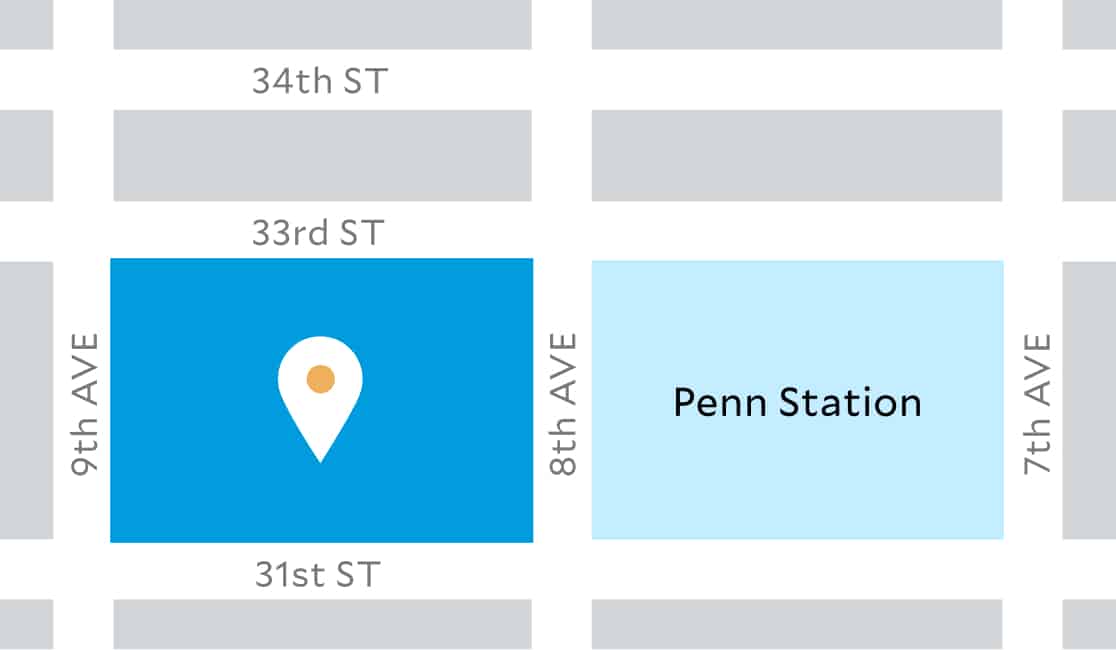

Wrong side exits kill pickups.
Always target the west side.
The Penn Station name trap (30 seconds)
Ask this before anyone panics:
“Are you at Penn Station NYC or Newark Penn Station?”
If the answer is Newark, no Manhattan curb plan applies yet.
Penn Station / Moynihan micro-table
| Rider says | You reply | Why |
|---|---|---|
| “Where’s Penn?” | “Moynihan, west side of 8th Ave.” | Stops 7th Ave wandering |
| “I’m outside Penn” | “W 33rd mid-block between 8th & 9th.” | One curb, no guessing |
| “It’s packed” | “Fallback: W 31st mid-block.” | Often cleaner flow |
Midtown East: curb reality
Midtown East is about doors, not avenues.
Avenue frontages = heavy enforcement
Side streets often allow legal, expeditious pickups
Build the walk into the script so the executive feels in control
Hudson Yards: stage smart
Frontage blocks jam fast.
10th / 11th Ave stack during demand spikes
Stage one block off
Use landmarks: hotel doors, numbered entrances, corners
Simple approaches beat clever routing.
Wall Street: move to the corner
During surges or security activity, curb space disappears.
Use building number + cross street
Corners are easier to see and approach
Stick to a predictable loop—random circling wastes minutes
Pickup scripts that actually work
Script 1 — Midtown
“Arriving now. I’m at [building #] [street], [side], by [landmark]. I can walk one block if needed.”
Script 2 — Penn / Moynihan
“Moynihan pickup: exiting to W 33rd St mid-block between 8th & 9th. I’ll text when curbside.”
Script 3 — Wall Street
“I’m at [building #]. If traffic stops, I’ll move to [corner of X & Y].”
Tools that help (without noise)
MTA Congestion Relief Zone site → definitions & official explanations
NYC311 idling guidance → fast rule reference
Navigation apps → routing only
Your curb plan handles legality.
Chauffeur’s professional takeaway
Congestion pricing outcomes hinge on one decision: the exit.
Stay on excluded roadways until the last clean turn. Enter once.
On the curb, treat No Standing as touch-and-go and idling as a timer you respect.
The rules are written—use them.
The “Meet-Me-Without-Drama” rule
Never say “I’m outside.”
Use:
[Building # + Street] + [side] + [landmark] + [walk ok]
Example:
“230 Park Ave, east side, main lobby doors. I can walk one block.”
Curb sign translator (NYC)
NO STOPPING → keep moving
NO STANDING → load and roll
NO PARKING → quick pickup ok
Idling enforcement is not optional.
FAQs
Can I avoid the CRZ toll using FDR or West Side Highway?
Yes—if you stay on them and don’t exit onto local streets inside the zone.
What’s the peak vs overnight toll for sedans with E-ZPass?
Public guidance commonly references $9 peak / $2.25 overnight.
How long can I idle in NYC?
Over 3 minutes, or 1 minute near a school, is illegal.
Final word
CT ↔ Manhattan transfers fail on small details:
wrong exits, early zone entry, illegal curbs.
Keep it clean:
Use MTA zone definitions as routing guardrails
Use NYC idling rules as waiting guardrails
Use Moynihan’s W 33rd / W 31st curbs as your Penn Station standard
CT Ride Car Service
Professional Chauffeured Transportation | Connecticut & New York
Built on reliability, legal precision, and calm execution—every ride, every meeting.
Also Read: What's Cheaper from JFK: Uber or Taxi
