
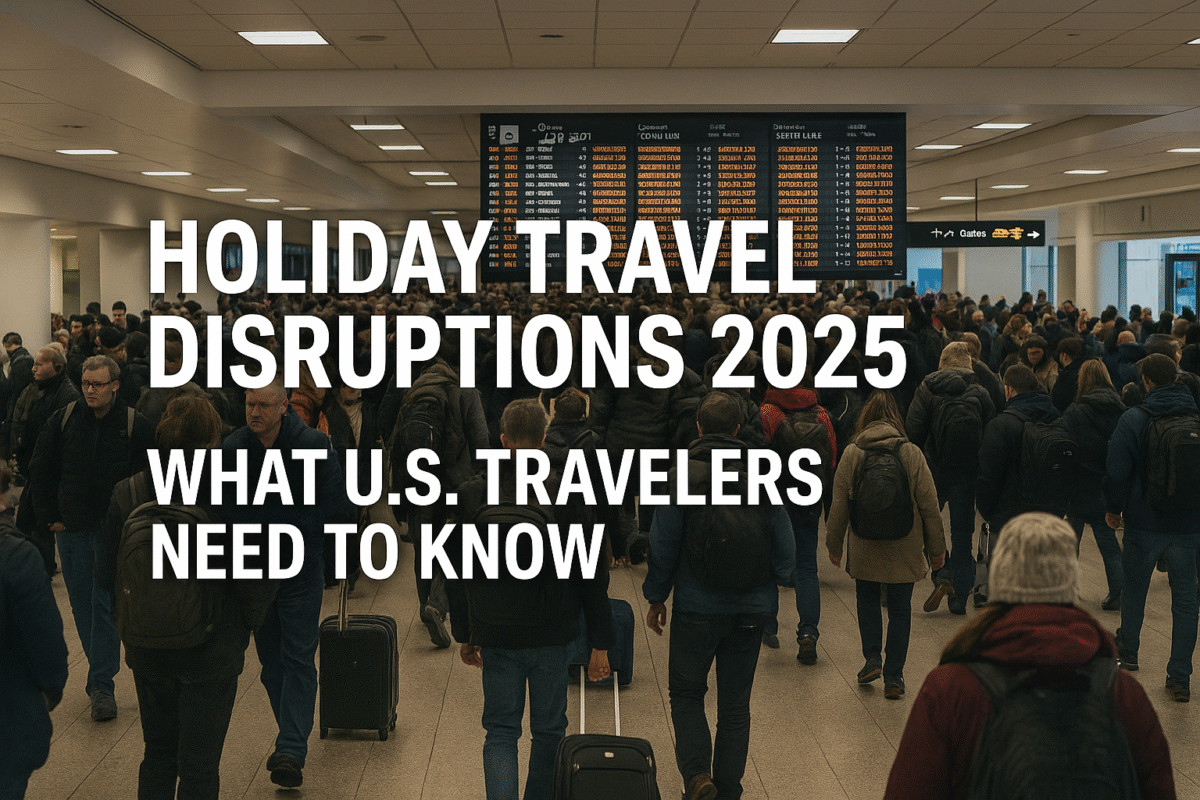
Holiday Travel Disruptions 2025: What U.S. Travelers Need to Know
A CT Ride Car Service Report
The 2025 holiday season has brought an intense wave of nationwide travel disruptions, leaving U.S. travelers facing one of the most challenging peak-season travel environments in recent years.
This year’s complications are not simply about holiday crowds—they represent a system-wide breakdown triggered by multiple crises hitting at the same time.
With more than 11,000+ delays and over 1,300 cancellations recorded on a single high-travel day, millions heading home for Christmas and New Year’s are struggling to adjust their plans.
To help passengers stay ahead, CT Ride Car Service breaks down the real causes behind this year’s nationwide travel complications.
Three Major Factors Behind the 2025 Holiday Travel Disruption
1. The Great Lakes & Northeast Winter Freeze

A powerful winter system stalled operations across the Midwest and Northeast, hitting major hubs like:
Chicago O’Hare (ORD)
Newark Liberty (EWR)
Boston Logan (BOS)
Detroit Metro (DTW)
Heavy snow, ice accumulation, and rapid-freeze conditions caused:
Runway shutdowns
Mandatory de-icing delays
Hundreds of displaced aircraft and crew
This gridlock spread nationally, delaying flights even in sunny destinations like Phoenix or Orlando.
2. Emergency Aircraft Software Inspections
As holiday travel peaked, airlines had to temporarily pull several aircraft from service due to a critical avionics software alert affecting multiple popular narrow-body jets.
This forced:
Emergency checks
Slower aircraft rotation
Reduced holiday capacity
Even a small reduction in aircraft availability becomes a crisis during high-volume travel periods.
3. Staffing Shortages & Federal Operation Slowdowns
A mix of staffing issues across federal agencies—including TSA, FAA, and Air Traffic Control—caused:
Longer security lines
Reduced hourly flight throughput
Ground delays at major airports
Airports simply couldn’t move travelers quickly enough to keep up with December’s record-breaking traffic.
What Holiday Travelers Should Do Immediately
1. Book the Earliest Flight of the Day
Flights between 6 AM – 8 AM have the highest on-time performance and are less affected by rolling delays.
2. Understand the Cause of Your Delay
If your delay is due to airline-controlled issues (mechanical, crew, software updates), you may qualify for:
Meal vouchers
Hotel accommodations
Rebooking flexibility
Weather delays do not qualify—so adjust expectations accordingly.
3. Consider Rail for Regional Travel
Amtrak’s Northeast Corridor has remained more stable than air travel during storms.
If flying between DC, NYC, Boston, or Connecticut, rail may be faster and more predictable.
4. Travel Carry-On Only When Possible
Assume checked bags may be delayed for 24–48 hours.
Keep essentials with you:
Medications
Travel documents
Chargers
Laptop/tablet
A GPS tracker in your luggage
Why More Travelers Are Turning to Private Car Services

With thousands of flight disruptions this season, passengers are increasingly relying on professional car services for stable ground transportation.
Unlike rideshare apps that surge pricing during storms and busy hours, CT Ride Car Service provides:
Guaranteed pickup times
Real-time flight monitoring
Skilled chauffeurs trained for winter conditions
Spacious SUVs and sedans for luggage-heavy holiday travel
Ground transportation has become essential for:
Travelers arriving on late-night rebooked flights
Families needing extra space
Business travelers on tight schedules
Passengers avoiding rideshare uncertainty
This shift reflects a national trend: people now plan their airport rides before booking their flights.
FAQ
What are the biggest challenges airports face this holiday season?
Airports are dealing with extreme passenger traffic, staffing shortages, weather disruptions, supply chain delays, and increased cybersecurity precautions.
Which airports have seen the worst outages?
System outages or slowdowns have been reported at:
LAX
ATL
ORD
JFK
These disruptions affect check-in, baggage systems, and communications.
What is the airline 2-hour tarmac rule?
Airlines must allow passengers to deplane after 2 hours on a domestic tarmac delay (4 hours for international), with limited exceptions for safety or ATC requirements.
Are system outages becoming more common?
Yes. Recent outages at major hubs like ATL, LAX, and ORD show a rising dependency on complex systems that can be affected by weather, cybersecurity precautions, and technical failures.
The Reliability Gap: Air Travel vs. Ground Transportation
The 2025 season has exposed a growing reliability gap:
While airlines face thousands of delays, professional ground transportation providers like CT Ride Car Service maintain high punctuality.
Why this gap exists:
Cars are not affected by airspace closures
Chauffeurs can reroute instantly around traffic
Schedules are far simpler than airline networks
Pricing is fixed and transparent, unlike rideshare surge costs
For many travelers, pre-booking private transportation has become a key part of stress-free holiday travel.
Conclusion
The 2025 holiday season has revealed just how vulnerable the U.S. aviation system is to:
Severe winter weather
Technical problems
Staffing shortages
Heavy passenger demand
As airlines struggle to regain stability, travelers are increasingly turning to dependable ground solutions.
CT Ride Car Service remains committed to providing reliable, comfortable, and secure transportation for airport trips, business travel, family holidays, and urgent rebookings.
By CT Ride Car Service
Connecticut’s trusted transportation provider for airport transfers, corporate black-car travel, special events, concerts, sports games, and long-distance rides across CT, NY, NJ & surrounding regions.
Also Read: Best Way to Get from O'Hare Airport to Downtown Chicago
